You're tasked with lighting a road, but the options are overwhelming. You choose the wrong solar light, and you could end up with a dark road, wasted money, and a failed project.
The best solar street light solution depends on your project's specific needs. For small paths, choose simple All-in-One lights 1. For main roads requiring high power, flexible Split-type lights are ideal 6. For guaranteed reliability, consider a city-power hybrid system 3.

In my years in this industry, from the factory to helping clients worldwide, I've learned there's no single "best" solar street light. It’s like asking what the best vehicle is; it depends on if you're crossing a desert or driving downtown. A solar street light is a complete system with five core parts: a solar panel, light source, controller, battery, and pole hardware 3. The way these parts are put together determines the light's performance. The market is full of options, mainly categorized by structure: All-in-One, Two-in-One, and Split-type lights 4. Let’s break them down so you can confidently choose the right one for your road.
Is the All-in-One light right for every road?
You need lighting for a small park path and want a simple solution. All-in-One lights look easy and modern, but you're worried they won't be powerful or reliable enough for the job.
No, All-in-One lights are best for small roads like courtyards and paths, especially in sunny, low-latitude regions 1. Their easy installation is a major plus, but their design limitations in power and angle make them unsuitable for most main roads 12.
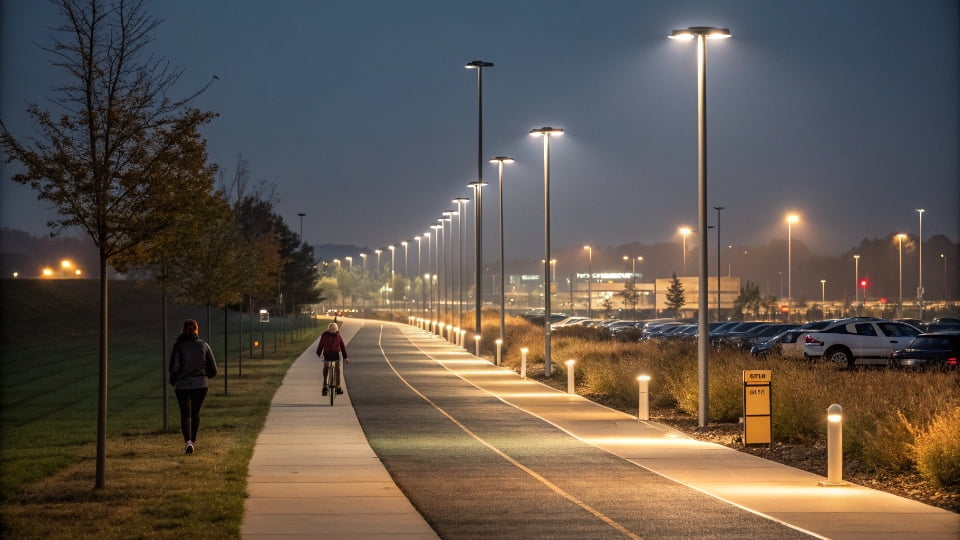
I often see All-in-One lights marketed as a universal solution, which can be misleading. While they are fantastic in the right context, their biggest strength—integration—is also their biggest weakness. I've worked on many projects shipping lights to Africa and Southeast Asia where these lights perform beautifully because the sun is strong and overhead 1. But I once had a client in a less sunny region insist on them for a town road. The result was dim lighting because the fixed, flat panel angle just couldn't generate enough power 2.
Understanding All-in-One Limitations
These lights integrate the panel, battery, controller, and light source into a single housing, which offers convenience but comes with trade-offs 2.
- Key Advantages: Their biggest pros are easy transport and installation. Since all components are integrated and pre-wired, the customer doesn't have to do any complex wiring, which is a huge convenience 2. The compact design also reduces shipping volume and cost 2.
- Major Disadvantages:
- Low Charging Efficiency: The solar panel is fixed to the back of the light fixture, typically at a shallow 15-degree angle 2. For most regions, the ideal angle for maximum sun exposure is 30-45 degrees, which means a 15-degree angle can reduce power generation by 2-3 times 2. Also, the panel's direction is dictated by the road, so it can't always face the sun 2.
- Limited Power: The size of the solar panel is restricted by the size of the lamp housing, which limits the total power it can generate 12. This, in turn, restricts the power of the LED light source and its working hours 1.
- High Maintenance Cost: If any single component fails, the entire unit must be dismantled and replaced, leading to higher after-sales costs 1.
When should you choose a Split-type light for maximum power?
Your project involves a main road that needs bright, reliable lighting all night long. You know an integrated light won't be enough, but you're unsure which system can handle the high power demand.
Split-type lights are the undisputed choice for high-power systems or projects requiring long working hours 6. Because each component is separate, you can use a large panel and battery to meet any demand, offering maximum flexibility and performance 46.
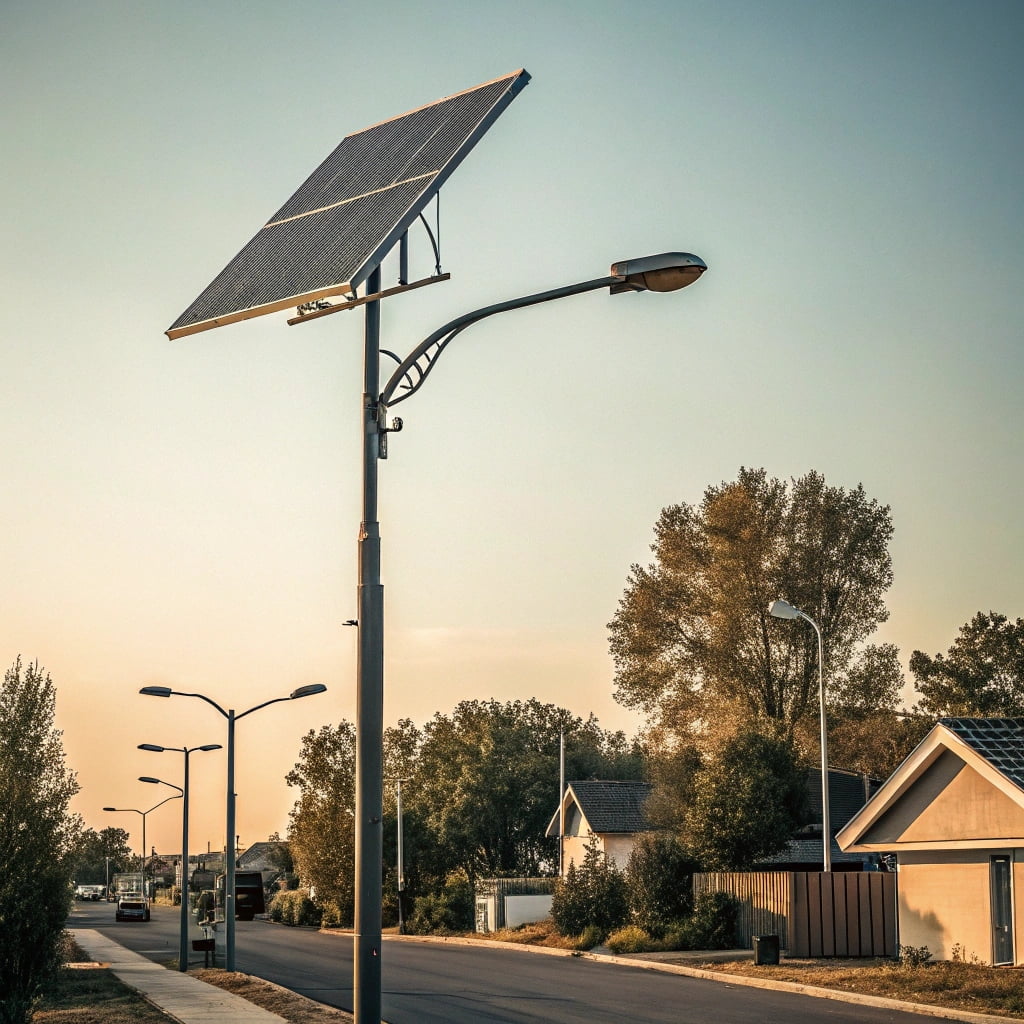
Split-type systems are the original solar street light design, and for good reason 4. They are the workhorses of the industry. When a client comes to me with specifications for a highway or a major municipal road, I don't even consider other options. The ability to customize every part separately is critical. We can select a massive solar panel, pair it with a high-capacity battery bank, and mount them for optimal performance, independent of the light fixture's position. While the rise of lithium batteries has made integrated lights popular for smaller systems, the dominance of split-type lights for large projects is unshakable 6.
The Flexibility of Split Systems
Their main advantage is that the components can be sized and configured with almost no limits 46.
- Unmatched Power: Because the panel and battery are not limited by the size of the lamp, you can design a system for any power requirement 6. This is essential for main roads that need bright light for vehicle traffic 3.
- Optimal Performance: You can mount the solar panel at the perfect angle and orientation to capture the most sunlight, regardless of the road's direction.
- Battery Choices: Split systems can use different battery types. While older systems used bulky gel batteries that were buried, modern systems use lighter, more efficient lithium batteries that are easier to install and have a much longer lifespan 6.
| Comparison | Gel Battery | Lithium Battery |
|---|---|---|
| Lifespan | 3 - 5 years | 8 - 15 years |
| Installation | Complex (6 wires), usually buried | Simple (plug-and-play), usually hung on pole |
| Size & Weight | Large and heavy | Compact and light |
| Performance | Less efficient, sensitive to cold | More efficient, better temperature range |
Source: Adapted from Reference 6
The main drawback is that installation is more complex, with more components and wiring, which increases the chance of errors if the installers are not professional 6.
Are hybrid systems a reliable alternative for your project?
You need 100% guaranteed lighting for a critical road, but you're in a region with frequent long, rainy spells. You're concerned that a pure solar system might not be reliable enough.
For absolute reliability, a city-power hybrid light is the best solution 3. It runs on solar power to save energy but automatically switches to the grid during long periods of bad weather, ensuring the light never fails. Wind-solar hybrids are rarely a good investment 5.
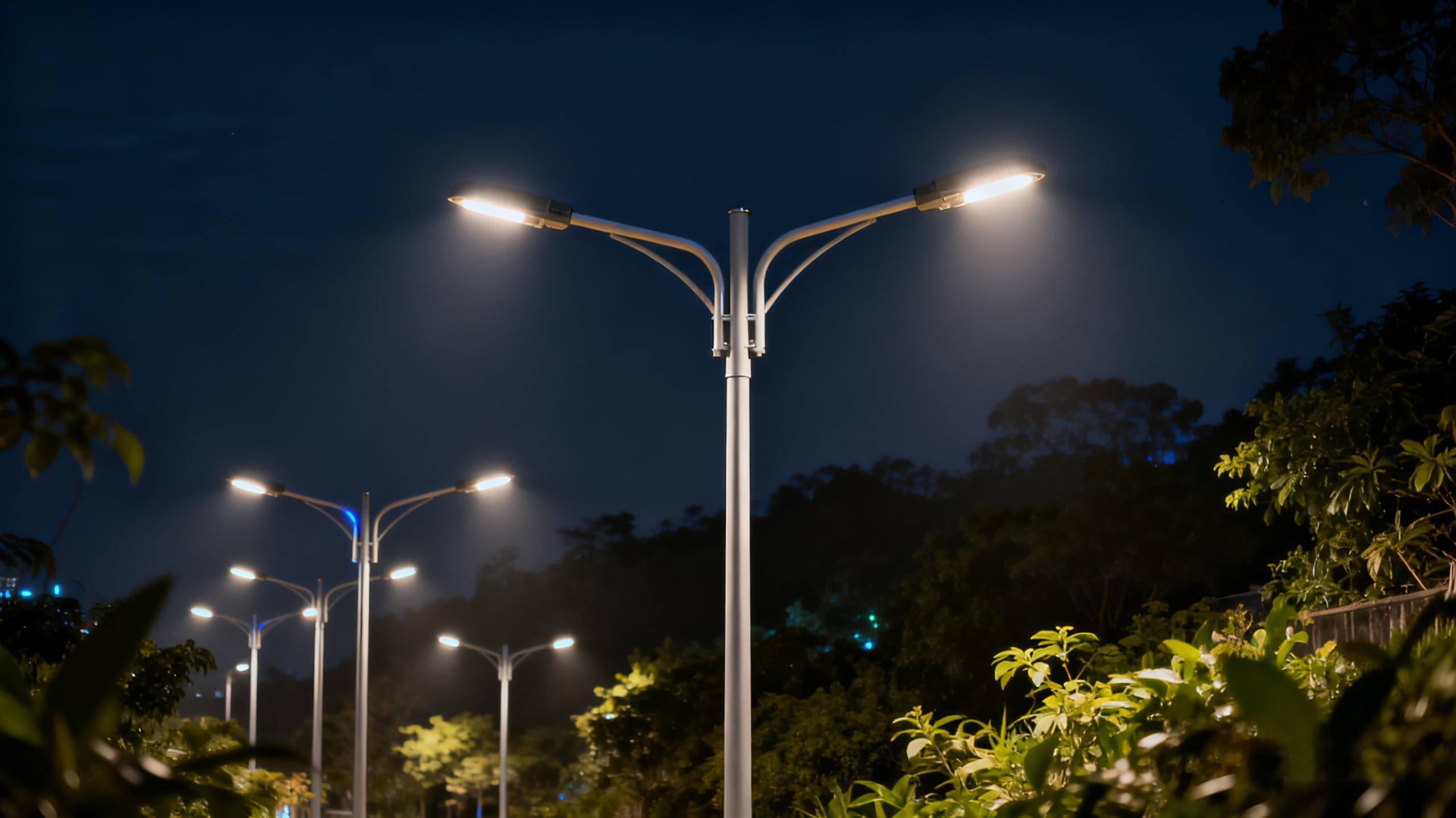
The idea of combining energy sources is very appealing. The goal is to cover the weaknesses of solar power, namely the lack of charging on cloudy days or at night 15. I've seen two main types of hybrids in the market: wind-solar and city-power. The wind-solar hybrid sounds great in theory, but in my experience, it's often a disappointment. The small wind turbines used on street lights are inefficient and need strong, consistent wind to be effective, which most places don't have 5. They also add significant cost and maintenance problems 5. However, the city-power hybrid is a different story. It’s a practical, robust solution that offers true peace of mind for critical infrastructure projects.
Choosing the Right Hybrid
- City-Power Hybrid: This system uses solar as its primary energy source, saving you money on electricity. But it remains connected to the electrical grid as a backup. If the battery runs low after several rainy days, the controller automatically draws power from the grid to keep the light on. This gives you the cost savings of solar with the 100% reliability of grid power 3. It's the ultimate fail-safe solution.
- Wind-Solar Hybrid: This system adds a small wind turbine to supplement the solar panel 1. The idea is that the wind can generate power when the sun isn't shining 5. However, these small turbines are often inefficient. They need sustained, strong winds (around 6-level winds) to charge the battery effectively 5. In most locations, the wind isn't strong or consistent enough to justify the high cost and extra maintenance of the turbine 5. I generally advise against this option unless the project is in a location with proven, exceptional wind resources 5.
Conclusion
Choosing the right solar light is simple when you match the technology to the road. Use All-in-Ones for small paths, Split-types for major roads, and hybrids for critical, no-fail applications.