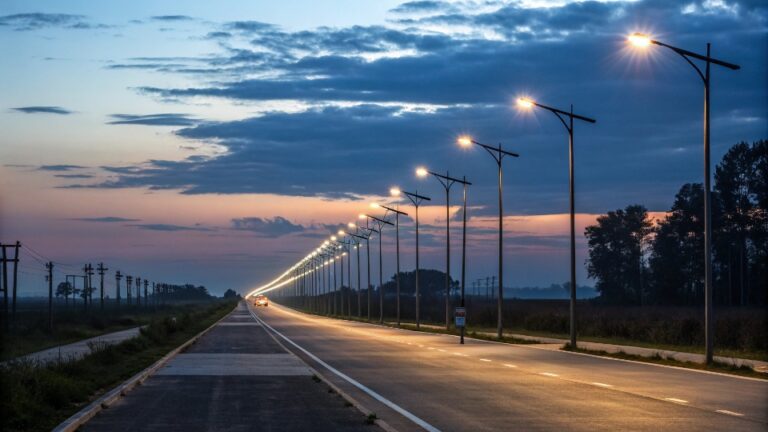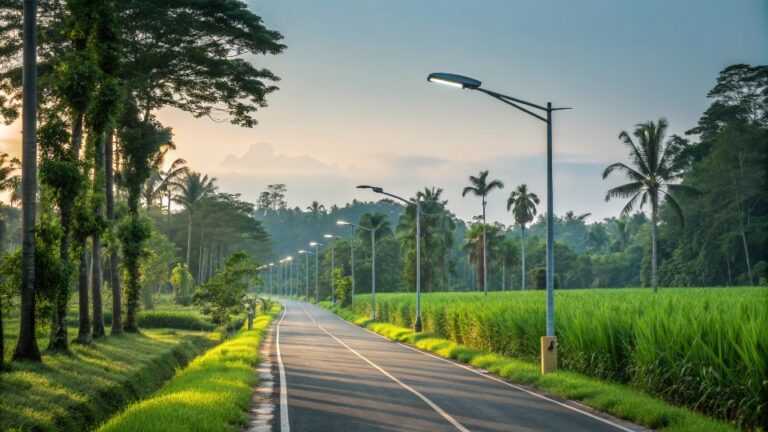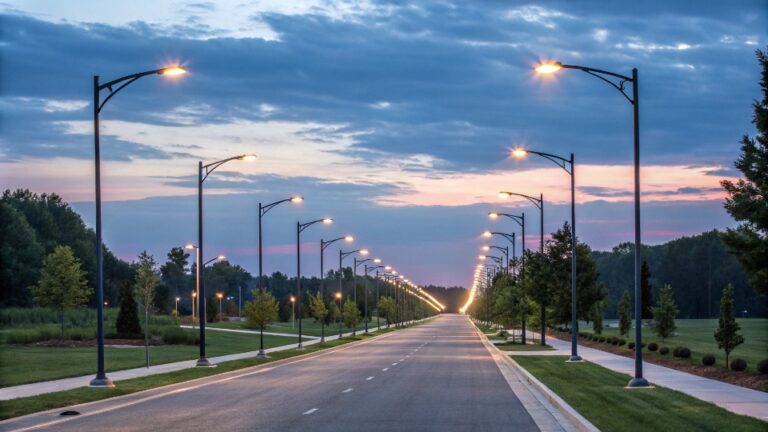
Choosing lights for the tropics is tough; heat and rain cause failures. You worry about investing in a system that can't handle the climate and will leave you in the dark.
For reliability in Southeast Asia, choose either a quality integrated light for its surprising efficiency in equatorial sun [1][2], or a robust, waterproofed split-type system with a large lithium battery for high-demand projects needing extended rainy-day backup [3][6].

When I first started exporting solar street lights, I thought a powerful system that worked well in Europe would work anywhere. A client in the Philippines quickly proved me wrong. His lights, which were top-of-the-line models, were failing after just one rainy season. My engineer, Bennett, wasn't surprised. He told me, "Kathy, you can't fight the environment. You have to choose technology that works with it." That lesson was crucial. Southeast Asia's tropical climate, with its intense heat, heavy rainfall, and unique solar conditions, demands a very specific approach to street lighting.
Why Do Ordinary Solar Lights Fail in Southeast Asia?
You invested in what you thought were good solar lights, but they dimmed or died after the first heavy rain. Now you're facing unexpected replacement costs and frustration with the technology.
Ordinary lights fail from water intrusion due to poor sealing, battery degradation from extreme heat, and inefficient charging because their design isn't suited for the region's specific solar conditions [1]. They are simply not built for the tropical environment.

A standard solar light isn't designed to be a submarine. But during the monsoon season in many parts of Southeast Asia, that's practically what's required. The combination of high heat and relentless moisture creates a brutal testing ground. A light that isn't specifically designed to handle these two factors will inevitably fail. We need to look at how the climate directly attacks a street light's most vulnerable points.
Climate Challenges vs. System Design Flaws
The failure of a solar light in the tropics is almost always a story of a design flaw meeting a climate reality. A system that works perfectly in a dry, temperate region will be quickly exposed in Southeast Asia. Here’s a breakdown of what goes wrong.
| Climate Challenge | Common Design Flaw in "Ordinary" Lights | Resulting Failure |
|---|---|---|
| Intense, All-Day Heat | Poor quality battery or battery placed in an unventilated housing. | The battery overheats, drastically reducing its lifespan and capacity. The light fails to last the night. |
| Heavy Rain & High Humidity | Low IP rating (poor waterproofing) and non-corrosion-resistant materials. | Water gets inside the lamp or battery box, shorting out the controller, LEDs, and battery terminals. |
| Suboptimal Sun Angle | Using a split-type light but installing the panel at a bad angle (e.g., flat). | The panel doesn't capture enough energy, especially if facing the wrong direction [1]. The battery never fully charges. |
An "ordinary" light often fails because it's a collection of compromises. For example, a manufacturer might use a cheaper, non-waterproofed battery box to cut costs. This is fine in a desert, but in a tropical downpour, it's a guaranteed failure point. Similarly, if installers aren't trained to angle a split-type panel correctly, its charging efficiency can be cut by more than half, starving the system of the power it needs to survive the rainy season [1].
Why Can Integrated Lights Be a Reliable Choice?
You see cheap, all-in-one integrated lights everywhere and assume they are all low-quality. You worry that choosing one is a risky bet that will lead to early failure.
A high-quality integrated light is surprisingly reliable in Southeast Asia because its main design flaw—a flat panel angle—becomes an advantage near the equator [1][2]. Combined with good waterproofing and a quality lithium battery, it becomes a very effective solution [6].

I was skeptical of integrated lights at first. The fixed panel seemed like a huge compromise [1]. But when we started shipping them to clients in low-latitude regions, the performance reports were excellent. The intense, high-angle sun completely compensated for the design's limitations [2]. The key, I learned, is that not all integrated lights are created equal. The difference between a reliable unit and a piece of junk comes down to the quality of its components.
Anatomy of a Reliable Integrated Light
The beauty of an integrated light is its simplicity, but that simplicity can hide either quality or fatal flaws. For the Southeast Asian climate, you must look for specific quality indicators.
| Component | Low-Quality Indicator | High-Quality Indicator for the Tropics |
|---|---|---|
| Battery | Recycled or low-grade cells with a short cycle life. | New, A-grade LiFePO4 (lithium iron phosphate) battery with a high cycle life (2000+) and good heat tolerance [6]. |
| Controller | Basic PWM controller, no waterproofing. | MPPT controller for higher charging efficiency, fully sealed in waterproof potting glue, with programmable time control [3]. |
| Housing | Low IP rating (e.g., IP54), thin plastic or standard steel. | High IP rating (IP65 or higher) to resist dust and heavy rain. Die-cast aluminum for heat dissipation and corrosion resistance. |
| Motion Sensor | Short-range, low-sensitivity sensor that activates too late. A "gimmicky" feature [2]. | Wide-angle, high-sensitivity microwave sensor that provides a useful path of light. |
A reliable integrated light is a system where every component is chosen to support the others in a harsh environment. The high-efficiency MPPT controller squeezes every bit of power from the panel to charge the durable lithium battery, all while being protected inside a waterproof, heat-dissipating aluminum shell. This is a world away from a cheap plastic model with a basic battery that will cook in the sun and flood in the rain.
When Are Split-Type Systems the Only Choice?
You have a major project like a highway or port that requires bright, reliable lighting 24/7. You know a compact, integrated light just won't be powerful or dependable enough.
A split-type system is essential for any project needing high-power lamps, guaranteed performance through long rainy seasons, or flexible installation [3]. Its ability to be customized with large panels and batteries makes it unbeatable for critical infrastructure [6].

No matter how good an integrated light is, it has a physical limit. As Bennett always says, "You can't cheat physics." The size of the lamp body limits the size of the panel and battery [1]. For a project that requires lighting a wide, multi-lane road, or needs to stay on for five consecutive rainy days, you need more power and more storage than an all-in-one design can ever provide. This is where the original, and still most powerful, design comes in: the split-type system [3].
Scaling Up for Power and Autonomy
The key advantage of a split-type system is its flexibility [6]. By separating the main components, you can size each one perfectly for the demands of the project, something that is impossible with integrated designs.
| Requirement | Why a Split-Type System is Essential |
|---|---|
| High Power (e.g., >60W lamp) | The lamp's power consumption is too high for the limited panel and battery of an integrated light. A split system allows for a huge solar panel to generate the necessary power [6]. |
| Long Rainy Day Backup (3-5+ Days) | Critical infrastructure cannot afford to go dark. A split system can be configured with a large battery bank (often buried for thermal stability) to provide multi-day autonomy [3]. |
| Difficult Orientation | If a road runs north-south, an integrated light's panel would face east or west, severely cutting its charging efficiency [1]. A split system's panel can be independently installed facing the optimal direction (south in the Northern Hemisphere). |
| Extreme Heat | While hanging a lithium battery is good, for the absolute best thermal protection and lifespan, burying a battery bank in a waterproof case keeps it at a stable, cool temperature year-round [6]. |
For a rural road or a park path in Southeast Asia, a high-quality integrated light is often the perfect, cost-effective choice [2]. But for highways, main city roads, industrial areas, and airports, there is no substitute for the raw power and reliability of a properly designed split-type solar street light.
Conclusion
Choose a reliable light for Southeast Asia by matching the technology to the need. Use quality integrated lights for general areas [2] and robust split-type systems for critical, high-power projects [3][6].