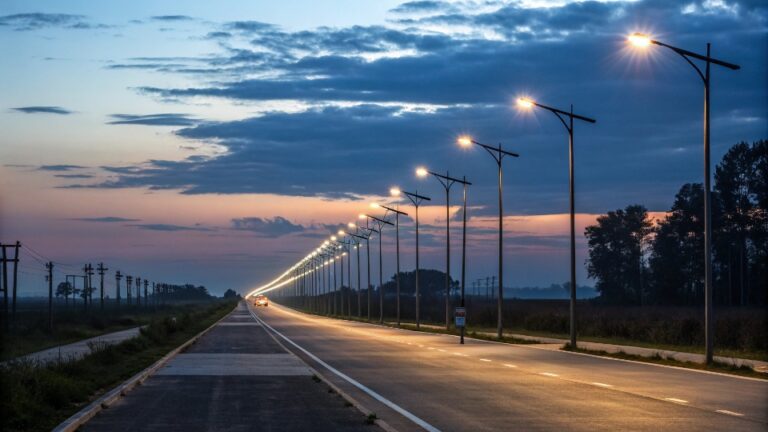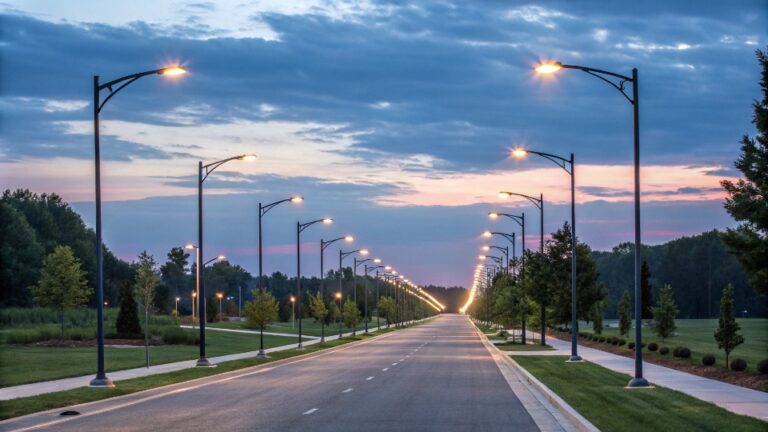
Choosing a solar street light seems easy, but poor quality leads to early failures and dark streets. You're worried about investing in a system that simply won't last.
To distinguish quality, you must look beyond the LED itself. Judge the entire system by its physical structure (split vs. integrated), its power strategy (hybrid options), and the practical implementation of its smart features, as these determine long-term reliability [2][3][6].

In my career, I've seen countless clients fixate on the wattage or brand of the LED chip. But as my lead engineer, Bennett, always reminds me, "A brilliant light is useless if the system powering it is flawed." From my early days in the factory, I learned that a street light's quality isn't just one part; it's how all the components—the panel, battery, controller, and lamp—work together as a cohesive unit [1]. Let's break down what truly separates a high-quality system from one that will fail you.
Does the Light's Structure Define Its Quality and Reliability?
Those sleek all-in-one lights look modern, but their design can hide serious flaws. You're concerned this convenient package might fail, leaving you with high replacement costs and a dead light [3].
Yes, structure is a primary indicator of quality and suitability. Split-type systems offer maximum performance and flexibility, while integrated lights often sacrifice efficiency and serviceability for the sake of easy installation, leading to higher long-term costs [2][3][4].

When split-type lights were the only option, everything was about customization for performance. The rise of integrated lights brought convenience, but I quickly learned it came at a price. Understanding the trade-offs between these designs is the first step in choosing a quality system.
The Different Structural Designs
A solar street light's physical design dictates its performance limitations and maintenance profile. There are three main types [2]:
| Structure Type | Description | Key Quality Indicator |
|---|---|---|
| Split-Type | The original design where the panel, battery, and lamp are all separate components [2]. | Offers the highest quality and performance, as each part can be sized and angled for optimal efficiency. |
| Semi-Integrated (Two-in-One) | Typically combines the battery and lamp into one unit, with a separate solar panel. | A compromise. Better than all-in-one but still has limitations, like fixed battery capacity which is problematic in cold regions [4]. |
| Integrated (All-in-One) | Combines the panel, battery, controller, and lamp into a single housing [4]. | Offers the most convenience but often the lowest performance and highest long-term cost due to design compromises [3][4]. |
The all-in-one design, while easy to install, has significant quality drawbacks. The solar panel is fixed flat on the housing, which severely reduces charging efficiency in most parts of the world where an angle of 30-45 degrees is needed [4]. Furthermore, if any single part fails, the entire unit must be replaced, making after-sales costs very high [3]. A quality system prioritizes performance and serviceability, which is why split-type designs are still the professional standard for critical road lighting.
Are Hybrid Systems a Sign of a Higher-Quality Light?
Worried about your lights failing during long, cloudy winters? Hybrid systems sound like the perfect solution, but they can introduce new costs and reliability issues you didn't bargain for [6].
Not always. The quality of a hybrid system depends entirely on the type. Grid-hybrid systems are a very reliable, high-quality solution for guaranteed uptime. However, wind-solar hybrids are often inefficient, costly, and high-maintenance, making them a poor-quality choice for most projects [5][6].

I had a client from a coastal area who was certain a wind-solar hybrid was the ultimate answer to their foggy seasons. The idea of capturing energy 24/7 is powerful. But when we analyzed the real-world performance and costs, it became clear that not all "smart" power solutions are a smart investment.
Wind-Solar Hybrid: A Good Idea, Poor Execution
The concept is to use a wind turbine to charge the battery when solar isn't available [3]. The reality is that the small turbines used are inefficient. They require strong and, more importantly, sustained wind (like a steady 6-level wind) to generate a meaningful charge, which is rare in most regions [6]. A quality turbine is also very expensive—sometimes as much as a whole street light set—and requires a stronger, costlier pole [6]. Using cheaper turbines to meet a budget often results in broken blades and controller failures, driving up maintenance costs and proving it to be a low-quality solution [6].
Grid-Hybrid: The Reliable Choice
A far higher-quality approach for reliability is the grid-hybrid system [5]. This system runs on solar power by default but is also connected to the electrical grid. When the battery runs low after extended bad weather, the controller automatically switches to grid power. This gives you the green energy savings of solar with the 100% reliability of the grid [5]. It's an excellent solution for upgrading old projects because the grid wiring is already in place. The mark of quality here is the reliability of the controller and the internal power supply that manages the switch from DC battery power to AC grid power [5].
Do "Smart" Features Indicate a Better-Quality Light?
Features like motion sensing and remote control sound impressive. But you're worried they might just be marketing gimmicks on a low-quality product that don't actually work when you need them [3].
Smart features only indicate quality if they are well-implemented. A programmable dimming schedule is a standard feature of any quality controller [2]. However, features like motion sensors on low-cost lights are often "gimmicky" and ineffective due to poor-quality components [3].

"Smart" is one of the most overused words in our industry. A truly smart light works efficiently and reliably without you having to think about it. A "smart" light that fails to perform its basic function is just a dumb light with expensive, broken features.
Quality Smart Feature: Time-Controlled Dimming
One of the most valuable smart features is the ability to program different brightness levels for different times of the night [2]. A high-quality controller will allow you to divide the night into multiple periods. For example, you can set the light to 100% brightness during busy evening hours, dim it to 30% during the quiet middle of the night to save energy, and then ramp it back up to 70% for early morning commuters [2]. This functionality is a hallmark of a quality system designed for maximum efficiency.
Gimmicky Feature: The Poor-Quality Motion Sensor
Motion sensing is a brilliant concept. The light stays dim until it detects a person or vehicle, then brightens to full power. However, to cut costs, many all-in-one lights use cheap sensors with very poor sensitivity and range. The light only brightens when you are already directly underneath it, failing to provide a safe path of light ahead [3]. The source material calls this a "gimmicky function" for a reason [3]. When evaluating a light with a motion sensor, the quality is determined by its specifications. Insist on a sensor with a wide and deep detection range to ensure the feature is useful, not just a bullet point on a brochure.
Conclusion
A high-quality LED street light is defined by a high-quality system. Judge it by its structure, power strategy, and the real-world performance of its features, not just its looks.