You need to light up a major road, but the standard all-in-one solar lights seem underpowered. You worry about choosing a system that can't handle the job, leaving your project in the dark.

Scalability in solar street lighting is the ability to customize and expand a system's components to meet specific, often high-power, demands [5]. This is the key feature of split-type systems, where the solar panel, battery, and light fixture are separate, allowing for flexible combinations to create powerful, reliable lighting for any need [5].
In my years in the solar lighting industry, I've seen that the biggest project failures often come from a misunderstanding of scalability. People are drawn to the simple, clean look of an all-in-one light, but they don't realize its limitations [2]. A solar street light isn't just one product; it's a power system made of five key parts: the panel, battery, controller, light source, and pole [3]. The ability to size each of these parts independently is what we call scalability, and it's the most important factor for serious lighting projects.
Why does scalability matter?
You have a specific lighting goal, like keeping a highway bright all night, even through a week of cloudy weather. An off-the-shelf light can't promise that. You're worried about investing in a system that isn't up to the task.
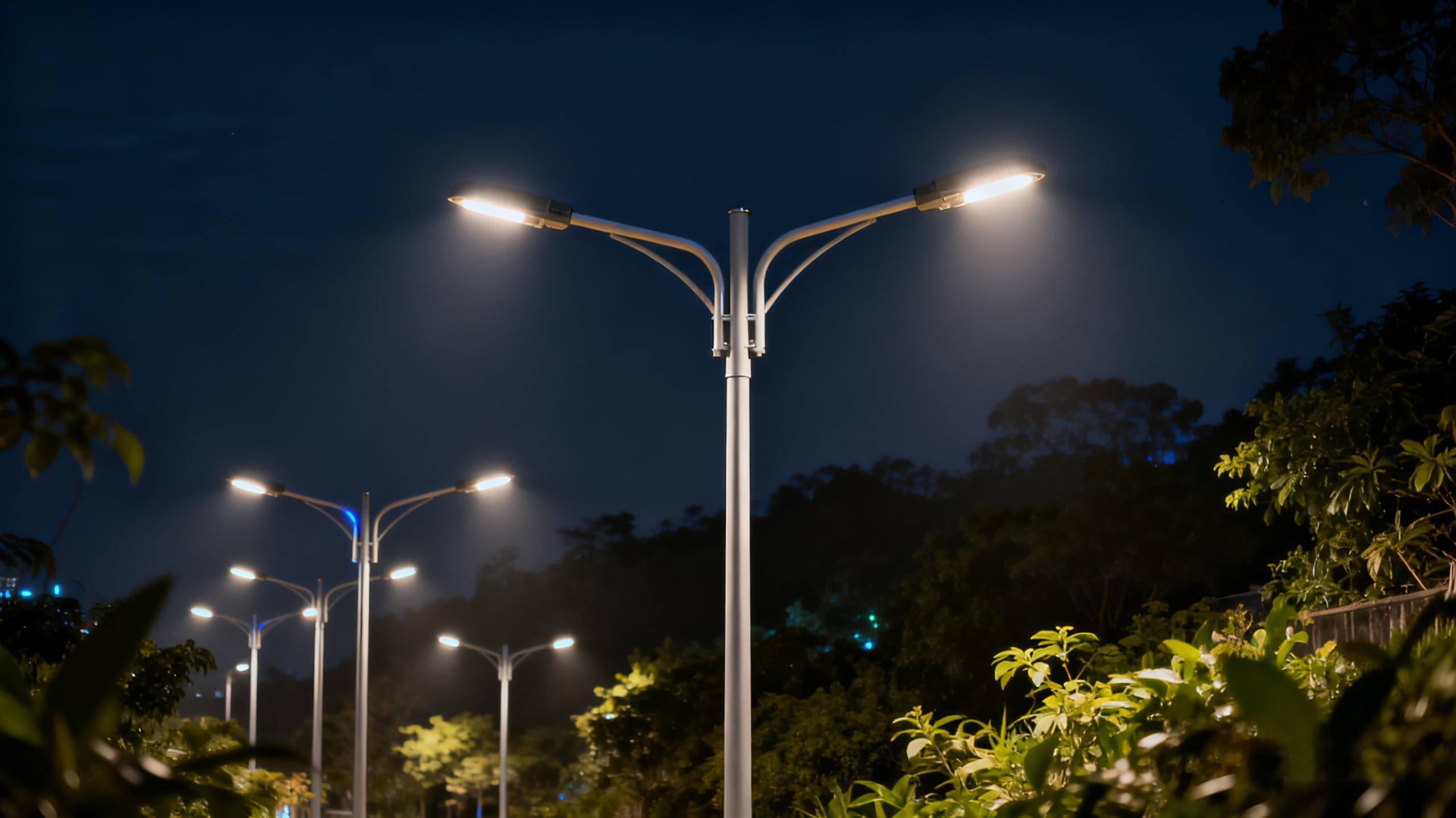
Scalability matters because it allows you to build a lighting system that perfectly matches the project's requirements, especially for high-power applications [5]. Unlike integrated lights with fixed components, scalable split-type systems let you choose the exact panel and battery size you need for powerful, reliable lighting [5].
The difference between a scalable and a non-scalable system is flexibility. My friend Bennett, who is a brilliant engineer, always says, "You can't fight physics." He's talking about the limitations of integrated lights. In an all-in-one system, the solar panel's size is restricted by the size of the light fixture it's attached to [2]. This puts a hard cap on how much power it can generate each day [1]. The battery compartment is also a fixed size, so you can't add more storage for long rainy periods [2][5]. Worse, the panel is stuck at the same angle as the light fixture, usually a shallow 15 degrees. In many parts of the world that need a 30-45 degree angle for the best sun exposure, this fixed position can cut power generation by half or more [2]. A scalable, split-type system solves all of these problems. You can use a massive solar panel and a huge battery bank if you need to. Each component is chosen for the job.
Scalable vs. Non-Scalable Systems
| Feature | Scalable (Split-Type) System | Non-Scalable (All-in-One) System |
|---|---|---|
| System Design | Components are separate and can be mixed and matched. Can be made very large and powerful [5]. | All components are integrated into one housing. Power and battery capacity are limited by the fixture's physical size [1][2]. |
| Solar Panel | Can be any size needed for the project. The angle can be adjusted independently for maximum efficiency [2][5]. | Size and angle are fixed and limited. This significantly reduces charging efficiency in many locations [2]. |
| Battery | Battery capacity is highly flexible. You can design for long rainy-day backups [5]. | Battery space is limited. Can't support high-power lights for long hours or many backup days [2][5]. |
| Installation | More complex, as all components must be wired together on-site, increasing the chance of errors [5]. | Very simple to install with no external wiring needed, which is a big advantage for smaller projects [2]. |
What are the applications of scalable solar street lights?
You understand the benefits of a powerful system, but where is it truly necessary? You don't want to overspend on a complex split-type system if a simpler all-in-one light is good enough.

Scalable, split-type solar street lights are essential for applications that demand high power, long working hours, or extended backup for rainy days [5]. This makes them the go-to choice for main roads, highways, and other critical areas where bright, reliable lighting is non-negotiable [3][5].
The choice comes down to the lighting requirements. An all-in-one light is a great solution for courtyards, parks, and small residential paths [1]. These areas have lower lighting needs, and the easy installation is a huge plus [2]. But when you move to roads that handle vehicle traffic, the demands change completely [3]. This is where the dominance of scalable, split-type systems is unshakable [5]. For example, a major rural road might need a powerful 80W light running at full brightness for 12 hours a night, with enough battery backup to last five rainy days. An all-in-one light simply cannot be built to meet these specs; its solar panel and battery are too small [5]. A split-type system, however, can be configured with a huge solar panel and a large battery bank to easily meet and exceed those requirements. This flexibility also makes them suitable for hybrid systems, such as wind-solar or city-power backup lights, which add another layer of reliability [1][3].
Conclusion
Scalability is the power to customize, a feature found in split-type systems [5]. It's vital for big projects needing powerful, reliable light, while simple all-in-one lights are perfect for smaller jobs [1][5]. By matching the system type to your project's specific demands—whether it's a quiet residential path or a busy highway—you can ensure your lighting investment is both effective and cost-efficient.