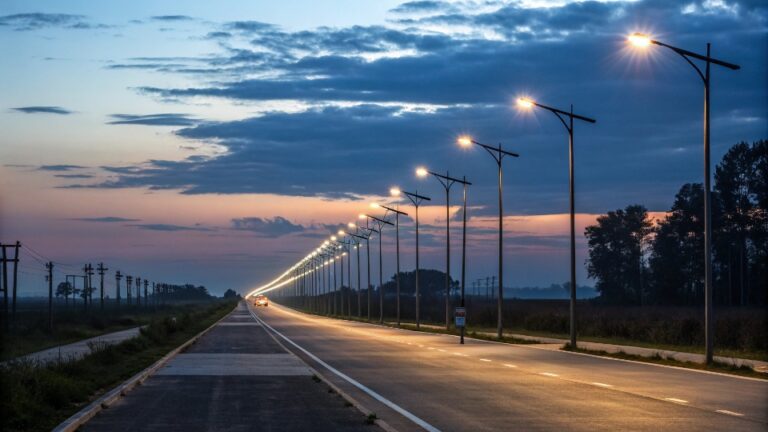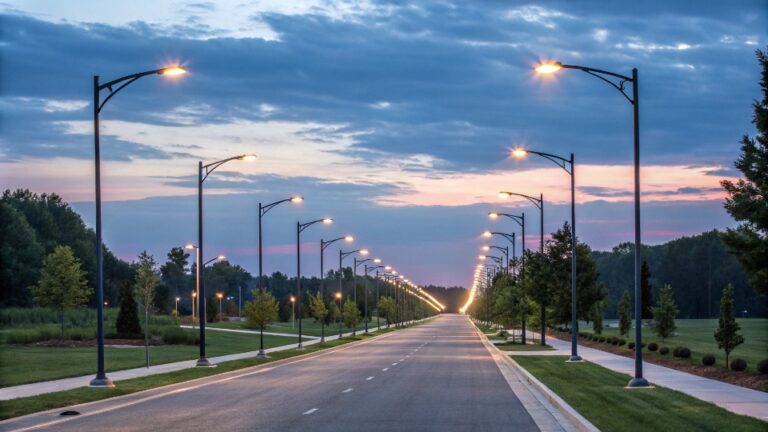
Installing lights too far apart creates dark spots, but placing them too close wastes money. You're stuck trying to find that perfect, cost-effective balance for your project.
For 6-meter solar street lights, a spacing of 18 to 20 meters is a reliable starting point. However, this distance must be adjusted based on the light's lumen output, the road's width, and the required brightness level on the ground to ensure even illumination.

I get this question all the time. People want a simple number, but as my head engineer Bennett always reminds me, the "right" spacing is more of a calculation than a rule. It's about ensuring every dollar you spend on a light pole contributes to a safe and well-lit road, without waste. It's one of the most critical factors in road lighting design, yet it's often overlooked in favor of just picking the cheapest light. Let's break down how to get it right.
How Does the Light's Power Affect Pole Spacing?
You see different power ratings and lumen outputs but don't know what they mean. Choosing a light with the wrong power will make your spacing calculations completely useless.
The power of the light, measured in lumens, directly impacts spacing. A more powerful, high-lumen light projects a larger pool of brightness on the ground, allowing you to space the poles further apart while maintaining sufficient illumination between them.

Think of lumens as the raw horsepower of the light fixture. The more lumens, the more light it throws. This directly affects the illuminance, or lux, which is the amount of light that actually reaches the road surface. Different types of roads have different lux requirements based on national standards [3]. A quiet rural lane might only need 5 lux, while a busier residential street needs 10-15 lux for safety. To achieve these levels, you must balance the light's power with its spacing. A lower-power light might be cheaper, but you'll need more of them placed closer together, increasing pole and installation costs. A higher-power light costs more upfront but covers a larger area, reducing the total number of poles needed.
| Light Power (Typical) | Recommended Spacing (for 6m pole) | Suitable For |
|---|---|---|
| 30W (~3,000 lumens) | 15 - 18 meters | Park paths, quiet lanes |
| 40W (~4,000 lumens) | 18 - 20 meters | Rural roads, residential streets |
| 50W (~5,000 lumens) | 20 - 25 meters | Wider two-lane residential streets |
How Does Road Width Influence the Layout?
You've got your spacing figured out for a narrow road, but the next project is much wider. Using the same single-sided layout will leave the center dark and unsafe.
Road width is critical. As the road gets wider, a single line of poles can no longer light it evenly. This forces you to use different layouts, such as staggered or opposite arrangements, which changes the effective spacing and total number of poles required.

For a 6-meter pole, a single-sided installation is standard for roads up to about 7 meters wide. The light can reach across the entire surface effectively. Once the road widens, you start getting a dark stripe down the middle, which is a major safety hazard. This is where you switch layouts. A staggered arrangement places poles on alternating sides of the road. While the linear distance between any two poles might increase, the goal is to create overlapping pools of light that cover the center. For very wide roads, like a four-lane street, an opposite arrangement with poles directly across from each other is necessary. This ensures full coverage but is also the most expensive option as it doubles the number of poles per kilometer. Therefore, you can't decide on spacing without first confirming the road's width and choosing the correct layout.
| Road Width | Recommended Layout | Pole Spacing Consideration |
|---|---|---|
| < 7 meters | Single-Sided | Standard 18-20m spacing. |
| 7 - 10 meters | Staggered | Spacing is measured between poles on alternating sides. |
| > 10 meters | Opposite | Spacing is measured between poles on the same side. |
Why Does the Type of Solar Light Matter for Spacing?
You just want a simple rule to follow. But different types of solar lights have different performance characteristics that can completely change your installation plan and its effectiveness.
The type of solar light—integrated or split—affects its power and light distribution, which in turn influences spacing [1][5]. An integrated light's fixed angle might limit its coverage [1], while a powerful split-type system can support a brighter lamp, potentially allowing for wider spacing [5].

When we choose a solar light, we're also choosing its limitations. An all-in-one integrated light is convenient, but its solar panel is fixed to the lamp body, often at a 15-degree angle to light the road [1]. This can affect the shape of the light pool on the ground. Its power is also limited by the lamp's physical size, which caps the panel and battery capacity [1][5]. In contrast, a split-type system is far more flexible. You can use a very large, powerful LED lamp because you can pair it with an equally large solar panel and battery bank [5]. This higher power output can create a wider, brighter light distribution, potentially increasing the spacing between poles. Furthermore, using smart controls to create different time periods of brightness can impact the design [4]. If the light runs at 30% power for 6 hours, the spacing must be close enough to ensure it still meets minimum safety illumination levels even at that dimmed state.
Conclusion
Ultimately, spacing 6-meter solar lights is a balance between pole height, light power, and road design. While 18-20 meters is a great guideline, always tailor it to your project.